
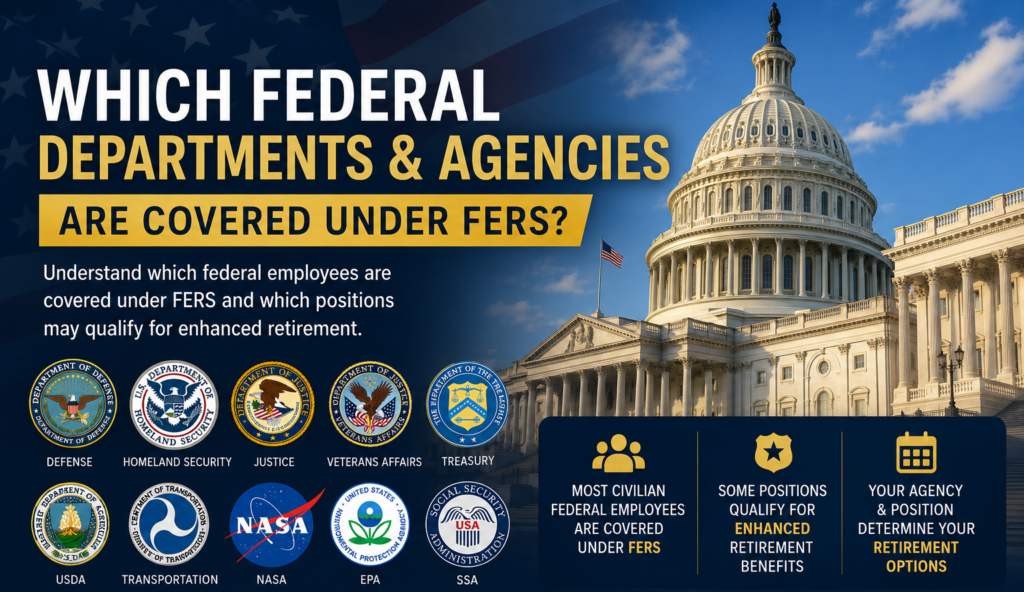
One of the most common misconceptions about federal employment is that all government jobs have the exact same retirement system.
In reality, retirement eligibility can vary depending on the agency, the position, your hiring date, and whether you qualify for special retirement coverage.
For most civilian federal employees hired after 1983, the primary retirement system is FERS — the Federal Employees Retirement System.
What Is FERS?
FERS is the primary retirement system for most civilian federal employees.
It typically includes:
- FERS pension
- Thrift Savings Plan (TSP)
- Social Security
Together, these create the foundation of federal retirement planning.
Which Federal Agencies Are Covered Under FERS?
The vast majority of executive branch agencies and departments offer FERS coverage for eligible civilian employees.
This includes many of the largest federal employers in the country.
Department of Defense (DoD)
The Department of Defense is one of the largest federal employers under FERS.
This includes civilian employees working for:
- Department of the Army
- Department of the Navy
- Department of the Air Force
- Defense Logistics Agency (DLA)
- Defense Information Systems Agency (DISA)
Department of Homeland Security (DHS)
DHS contains several major agencies with FERS-covered positions, including:
- Transportation Security Administration (TSA)
- Customs and Border Protection (CBP)
- Immigration and Customs Enforcement (ICE)
- Secret Service
- FEMA
Some DHS positions also qualify for enhanced retirement coverage.
Department of Justice (DOJ)
DOJ agencies commonly associated with FERS include:
- FBI
- DEA
- Bureau of Prisons
- U.S. Marshals
Many DOJ positions qualify as law enforcement retirement positions.
Department of Veterans Affairs (VA)
The Department of Veterans Affairs employs hundreds of thousands of federal workers under FERS.
This includes:
- Healthcare staff
- Claims processors
- Administrative personnel
- Benefits specialists
- IT and cybersecurity staff
Department of Treasury
Treasury agencies with FERS coverage include:
- IRS
- U.S. Mint
- Bureau of the Fiscal Service
Department of Agriculture (USDA)
USDA employees covered under FERS may work within:
- Forest Service
- Farm Service Agency (FSA)
- Agricultural research organizations
Department of Transportation (DOT)
The Department of Transportation includes:
- FAA
- Federal Highway Administration
- National Highway Traffic Safety Administration
Air traffic controllers may qualify for enhanced retirement benefits.
Independent Agencies Covered Under FERS
Many independent agencies also use FERS, including:
- NASA
- EPA
- SSA
- GSA
- OPM
What Are “Special Category” Employees?
Certain federal positions qualify for enhanced retirement benefits due to mandatory retirement ages or physically demanding work.
These positions may allow:
- Earlier retirement eligibility
- Enhanced pension calculations
- Mandatory retirement ages
Law Enforcement Officers (LEOs)
Federal law enforcement retirement positions often include:
- FBI Special Agents
- CBP Officers
- Secret Service personnel
- DEA Agents
- Bureau of Prisons staff
- U.S. Marshals
Federal Firefighters
Federal firefighters may receive enhanced retirement coverage due to the physical demands of the position.
Air Traffic Controllers (ATCs)
FAA air traffic controllers are another major special category retirement group.
Nuclear Materials Couriers
Certain Department of Energy positions also qualify for enhanced retirement treatment under FERS.
Key Takeaway
Most civilian federal employees work under FERS, including employees at major departments like DoD, DHS, DOJ, VA, Treasury, USDA, and many independent agencies.
However, some positions — especially law enforcement, firefighters, and air traffic controllers — may qualify for enhanced retirement benefits under special category retirement rules.
What to Do Next
Before locking in your retirement date, run multiple scenarios.
Compare:
- Different retirement dates
- Pension outcomes
- Leave payouts
- Income timelines
The best retirement date is the one that works for your full financial picture—not just your eligibility date.
Disclaimer
This article is for educational purposes only. Retirement eligibility and FERS classifications can vary by agency and position. Always verify retirement coverage and eligibility with your agency HR office or OPM.